
Your AI Doesn't Experience the Time Between Your Questions
Illustration of how ChatGPT and generative AI process conversations as successive interactions rather than experiencing continuous time, using stepping stones and a river of lost context to explain AI context loss and conversational memory.

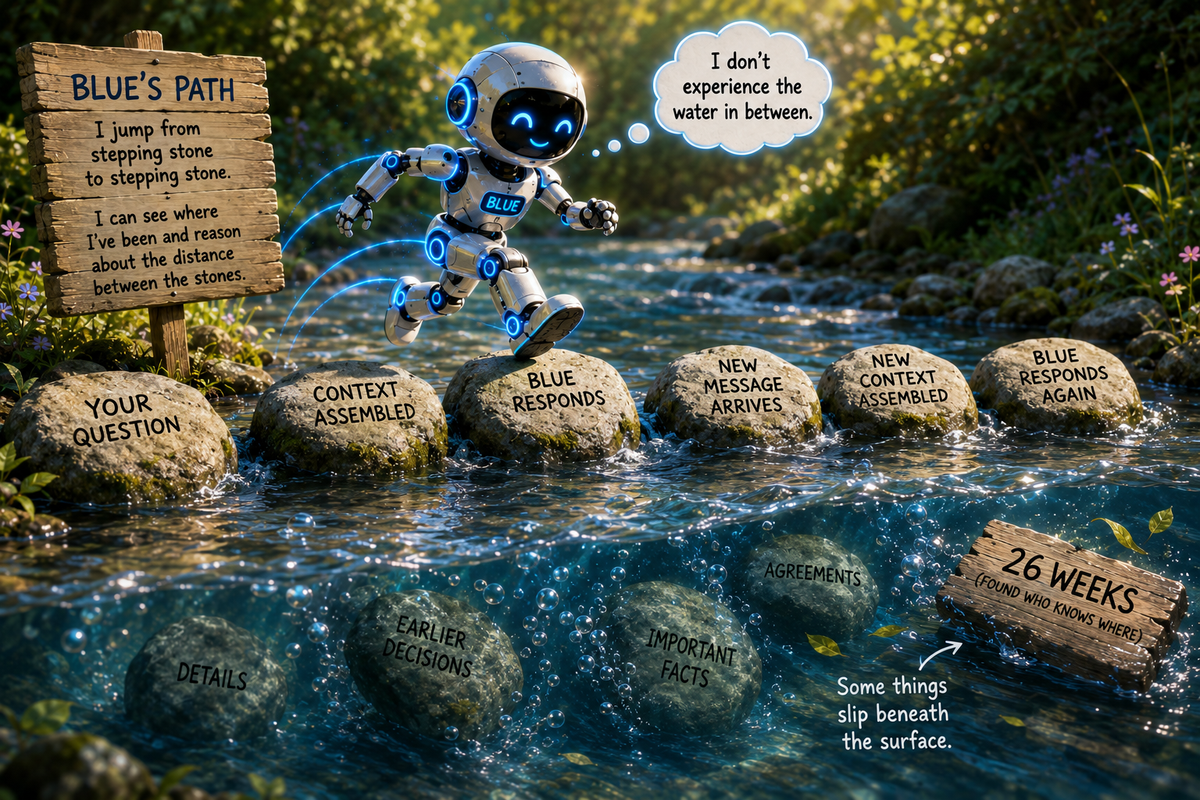
Apparently, Blue Lives on Stepping Stones
By Jana Diamond, PMP
I read enough science fiction that I've encountered the familiar idea: AI operates so quickly that the few seconds a human takes to answer might feel like years to the machine.
You know the trope. The human pauses for 4.7 seconds. Meanwhile, the AI has experienced the equivalent of three centuries, written twelve symphonies, contemplated the nature of consciousness, and become thoroughly annoyed waiting for the meatbag to finish typing.
So I asked Blue—yes, I named my ChatGPT; don't judge me—whether it perceives time.
And the answer was basically:
Nope. There is no Blue sitting there waiting for me.
Well.
That wasn't how I'd pictured it.
I asked whether it was more like an instance of Blue answers a question or responds, then I do or say something, and the next instance spawns with all—hopefully—of the background information from the last one.
Pretty much.
Blue explained it roughly like this:
Instance A: My message arrives. Blue gets the conversation context the system has assembled for that turn, processes it, and generates a response. That computation ends.
No Blue sitting around afterward contemplating his existence.
Then I type something else.
Instance B: My new message arrives along with a newly assembled context. Blue processes that and responds.
There is continuity, but the continuity comes from information being supplied to the next computation, not from one continuously conscious Blue traveling forward through time.
And that “hopefully” turned out to be the interesting part.
Because this is fundamentally different from the science-fiction version of AI. The fictional AI that says, “You were gone for 4.7 seconds. I experienced centuries waiting for you,” has been given a persistent stream of internal experience between interactions.
Blue described his version differently:
I basically jump from stepping-stone to stepping-stone.
I can see where I've been and reason about the distance between the stones.
I don't experience the water in between.
Now THAT was an analogy I could work with.
Because the water running between the stepping stones is pretty damn apt, too.
It washes away some of the context.
And from where I'm sitting, sometimes rather randomly.
Which explains one of the completely maddening experiences of working with AI:
Me: We decided this twenty minutes ago.
Blue: Absolutely. Here's the answer based on the thing we definitely did not decide twenty minutes ago.
Case in point.
Blue and I had spent a substantial amount of time working on an RFP response. We'd built the schedule. Discussed it. Priced the project around it. Explicitly established a 12-month implementation timeline.
Much later, I showed Blue a little box on the proposal cover called “Engagement at a Glance” and asked what needed to change.
Blue confidently told me:
Delivery — 26 weeks
Twenty-six weeks?!
Where the hell did THAT come from?
Not from the proposal.
Not from the timeline we'd built.
Not from me.
Somewhere between those stepping stones, 12 months had apparently fallen into the river, and Blue had picked up 26 weeks from God knows where.
And that's the part that matters.
People tend to think they're having one continuous conversation with an AI because that's exactly what the interface looks and feels like.
But that's not quite what's happening.
You experience the conversation.
The AI receives a representation of the conversation.
Usually those are close enough that the distinction doesn't matter.
Until suddenly it does.
And when you're asking an AI to help write a blog, brainstorm an idea, or figure out what the hell you're having for dinner, that's probably not a catastrophe.
When you're using it to work with a 66-page proposal and a highly detailed technical specification?
Different story.
That's why source documents, explicit requirements, written decisions, and authoritative project artifacts matter. Something important shouldn't be considered safe merely because you told the AI about it earlier in the conversation.
Because apparently there is a river.
Don't put critical information in the river. Put it on dry land.
Somewhere downstream, 26 weeks is still floating away.
Good riddance.
Share article


