Your AI Demo Works. So What?
A successful AI demo proves a system can work. Real evaluation measures whether it consistently works better by testing correctness, speed, and cost against repeatable benchmarks.

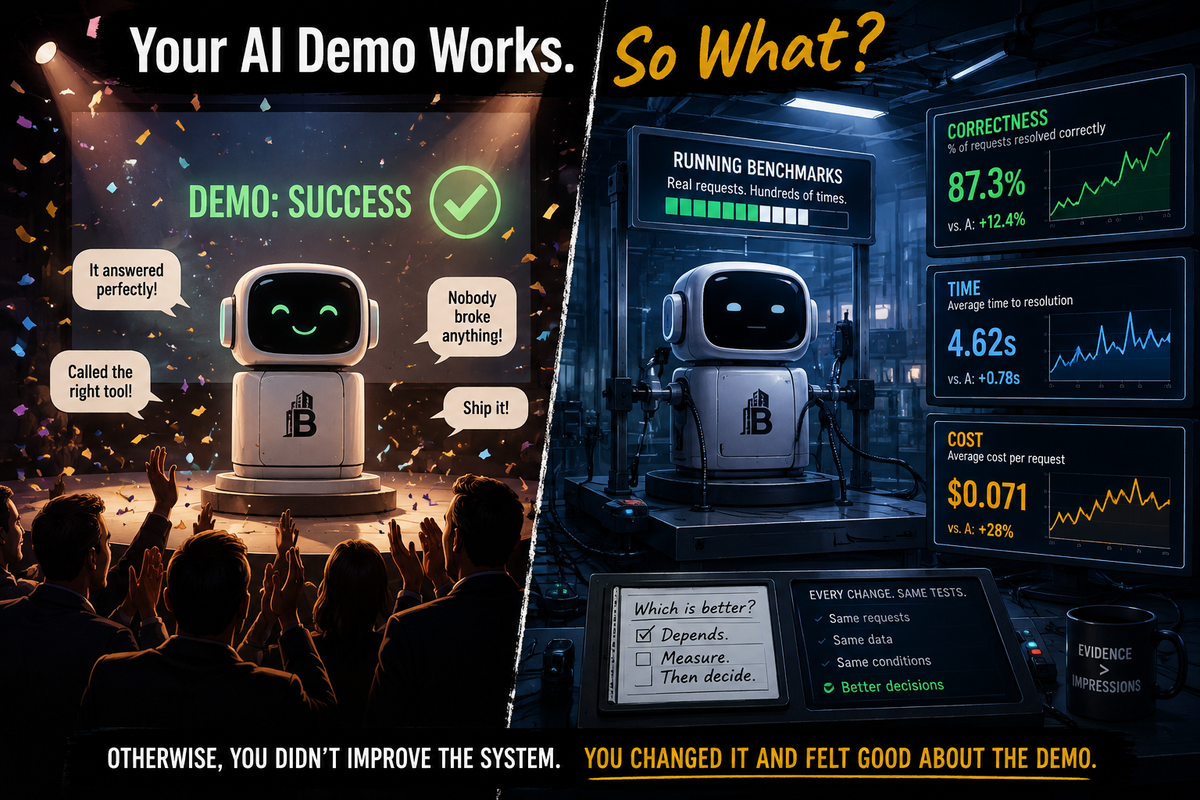
If you can’t measure whether version B is better than version A, you’re guessing with confidence.
By Audriana “Kat” Powell
The demo worked.
The AI answered correctly. It called the right tool. Nobody broke anything.
Excellent.
Now do it again.
And again.
And again.
Because one successful demo proves that your AI system can work.
It doesn't tell you how often it will.
The Guardrail Worked
On Bradley, our conversational facilities management assistant, we needed guardrails around the main conversation.
We used small, fast model calls to check for things like profanity, prompt-injection attempts, and genuine emergencies that needed to bypass the normal flow and escalate immediately.
Good idea.
Then real users showed up.
One of our guardrails started identifying people spelling out building names letter by letter as a hacking attempt.
The guardrail worked.
It was also wrong.
That's exactly the kind of problem you don't discover by showing somebody a successful demo.
You discover it by testing what happens over and over, with inputs that don't politely behave the way you expected them to.
Better According to What?
AI systems have a nasty habit of looking improved long before you've demonstrated that they are.
Change the prompt.
Try five examples.
They look better.
But did the system actually get better?
For Bradley, I wanted “better” to mean something we could measure.
So I built the evaluation framework around three things:
Correctness. Did it get the right answer?
Timing. How long did it take to get there?
Cost. How much did it cost to produce that result?
Because improving one can make another worse.
A new prompt might be more accurate but substantially slower.
A different model might answer faster but cost considerably more.
A cheaper approach isn't much of a bargain if it gets more answers wrong.
Looking at a handful of successful conversations won't show you those tradeoffs.
The numbers will.
Run the Same Test Again
I built a browser-based prompt editor with a benchmark runner attached.
The idea was simple: stop deciding whether a prompt was better by looking at a handful of conversations.
At first, that level of evaluation seemed unnecessary. We had an experienced technical team. We could look at the results and tell whether a change was better.
Except “looks better to us” isn't a metric.
So I built a benchmark from real historical service requests. We could run different prompt versions against the same problems and compare the results.
Now the conversation didn't have to be:
Version B seems better.
It could be:
Version B resolves 12% more requests correctly than version A.
And because we were measuring timing and cost too, we could see what we had traded to get that improvement.
Maybe 12% better correctness was worth a little more latency.
Maybe it wasn't worth twice the cost.
Now we could have that conversation with evidence instead of impressions.
The evaluation work could also happen in parallel with development. Prompts could change, benchmarks could run, and we could measure the effect without turning development into a bottleneck. That parallel evaluation workflow is also described in Prateek Sharma's broader account of the Bradley project.
The Demo Isn't the Test
Demos matter.
They're useful for proving an idea is possible and showing people how a system could work.
But they're also unusually friendly environments.
You know what you're about to ask.
You know what the system is supposed to do.
And nobody has arrived yet spelling out the name of a building and accidentally convincing your security system they're attacking it.
Real users will take care of that part.
So before you declare the latest prompt, guardrail, or model an improvement, ask a harder question:
Can you prove version B performs better than version A?
And while you're at it, define what better means.
More correct?
Faster?
Cheaper?
Some acceptable balance of all three?
Otherwise, you didn't improve the system.
You changed it and felt good about the demo.
Want to know more? See the White Paper here: https://blog.protovate.ai/we-stopped-paying-per-token-and-put-the-models-on-our-own-machine/
Originally published on Protovate.AI
Protovate builds practical AI-powered software for complex, real-world environments. Led by Brian Pollack and a global team with more than 30 years of experience, Protovate helps organizations innovate responsibly, improve efficiency, and turn emerging technology into solutions that deliver measurable impact.
Over the decades, the Protovate team has worked with organizations including NASA, Johnson & Johnson, Microsoft, Walmart, Covidien, Singtel, LG, Yahoo, and Lowe’s.
About the Author