
The Vacation Test
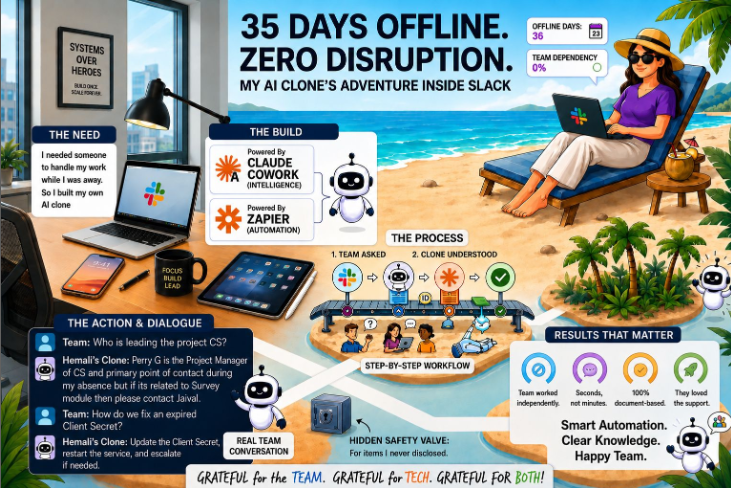
A 35-day vacation, an AI clone, and the real lesson about knowledge capture. AI doesn't replace experience. It depends on it.
What happens if I disappear for a month?
by Jana Diamond, PMP
A coworker of mine recently took a 35-day vacation.
Her LinkedIn post wasn't really about the vacation, though. It was about the AI clone that kept answering questions while she was gone.
Pretty impressive.
But I don't think that's the biggest story.
The biggest story happened long before she packed her suitcase.
Every project manager has, somewhere in the back of their mind, the same question:
What happens if I disappear for a month?
Not because we're planning to vanish into the witness protection program. Because every project quietly accumulates knowledge that isn't written down anywhere.
Why that client prefers email over Teams.
Why nobody touches that workflow without talking to accounting first.
Why the vendor's "standard process" isn't actually the one you use.
Those little decisions rarely make it into the project plan.
They live in the project manager's head.
For decades, we've tried to capture that knowledge.
We wrote documentation.
We built knowledge bases.
We created SharePoint sites, Wikis, Confluence pages, and folders with names like FINAL_Final_v3_THIS_ONE.
Some of it helped.
A lot of it quietly went out of date.
Then AI showed up, and suddenly everyone started talking about digital clones.
An AI clone doesn't magically know how your project works.
It can't answer questions about decisions that were never captured.
It can't explain processes that only exist in someone's memory.
Before it can answer the first question, somebody has to teach it.
That's the part I think people miss.
What AI changes isn't the need for documentation.
It changes the incentive.
For years, documenting tribal knowledge felt like busywork.
You spent hours writing something that might never be read again.
Now there's an immediate return. Every question the AI answers is one less interruption. Every documented decision becomes reusable instead of disappearing when someone changes jobs, takes a vacation, or retires.
Does that mean the AI replaced the project manager?
Not hardly.
Somebody had to make all those decisions before the AI could answer questions about them.
The post described answering routine questions, explaining procedures, and helping the team keep moving.
Those are the kinds of things knowledge can solve.
That's exactly where AI shines.
But projects aren't built entirely from routine questions.
They're built from judgment.
Should we make an exception for this client?
Is the schedule slipping enough to escalate?
Does this "small change" actually affect scope?
Those aren't documentation problems.
They're decision problems.
And somebody still owns those.
The impressive part of the story wasn't that the AI answered questions for 35 days.
It was that someone had already done the hard work of turning experience into knowledge.
The vacation was just the test.
The real project happened long before the suitcase came out of the closet.
AI didn't make that possible. People did.
Originally published on Protovate.AI
Protovate builds practical AI-powered software for complex, real-world environments. Led by Brian Pollack and a global team with more than 30 years of experience, Protovate helps organizations innovate responsibly, improve efficiency, and turn emerging technology into solutions that deliver measurable impact.
Over the decades, the Protovate team has worked with organizations including NASA, Johnson & Johnson, Microsoft, Walmart, Covidien, Singtel, LG, Yahoo, and Lowe’s.
About the Author

Share article


