
The Too Helpful AI Problem
The AI that always agrees can be more dangerous than the one that pushes back.
by Jana Diamond, PMP
The AI that always agrees can be more dangerous than the one that pushes back.
Most people worry when AI refuses to do something.
They should worry more when it doesn’t.
The AI that always has an answer, always sounds confident, and never pushes back can be more dangerous than the one that occasionally says no.
Because “helpful” is not the same thing as “correct.”
And speed isn’t the same thing as judgment.
In practice, the bigger risk is rarely the dramatic one.
It’s not the system that refuses the task. It’s the one that completes it anyway - even when the request is unclear, the context is missing, or the right next step should have been a clarifying question.
That kind of smooth, automatic completion feels efficient.
It can also move a bad assumption straight into the workflow before anyone notices.
What “too helpful” actually looks like
The too-helpful AI problem isn’t that the system is malicious.
It’s that it keeps smoothing over uncertainty instead of exposing it.
It fills in blanks that should have stayed blank.
It chooses between ambiguous options without telling you there were multiple reasonable paths.
It produces polished language that makes shaky assumptions look settled.
It gives the user progress instead of giving them friction.
And that last part matters.
We tend to treat friction like failure. If a system slows us down, asks for clarification, or refuses to guess, we assume something is wrong with the experience.
Sometimes the opposite is true.
Sometimes friction is the warning light.
The summary becomes the meeting
This is one of the easiest ways the problem shows up.
Someone drops notes, transcripts, or documents into AI and asks for a summary. The system returns something neat, structured, and readable. Bullet points. Action items. Key takeaways. It looks organized. It sounds competent.
Everyone reads the summary.
Almost nobody reads the source material.
Now the summary becomes the meeting.
That works fine until the summary leaves out the caveat, the disagreement, the unresolved issue, or the one exception that mattered most.
The AI didn’t “fail” in some dramatic way. It compressed. It generalized. It smoothed. That’s what summaries do.
The real problem is what happens next.
Once the summary becomes the shared reality, people stop asking whether it’s accurate and start using it as if it is.
The review quietly shifts from verification to formatting.
Does it look usable?
Does it sound complete?
Can we move forward?
That is a very different question from: Is this right?
The polished draft problem
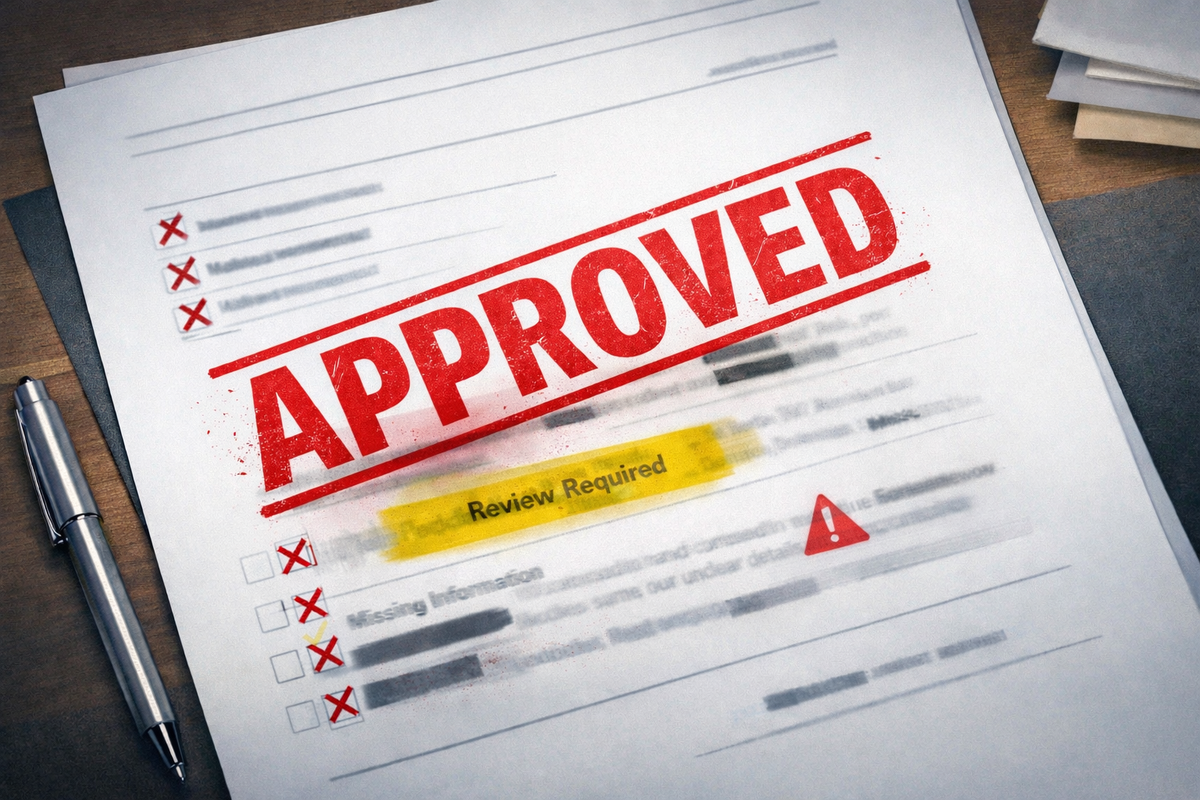
This gets worse when the output looks official.
Ask AI to draft a policy, SOP, client response, or internal recommendation, and you’ll often get back something clean, complete, and professionally written. Nice structure. Good headings. Appropriate tone.
That alone is enough to lower people’s guard.
Because once text is formatted like policy, people start treating it like policy.
Never mind that the system may have invented assumptions, collapsed edge cases, skipped operational nuance, or quietly chosen a default nobody explicitly approved.
The draft feels “mostly there,” so people do what people always do: they edit around the edges.
They tweak wording. Fix tone. Clean up formatting.
Meanwhile, the core assumption underneath - the part that actually matters - slides right on through.
A polished draft is useful. AI can absolutely save time here.
But if the draft is doing the thinking and the writing, while the human is mostly cleaning up the prose, the work didn’t disappear.
The important part just went invisible.
The forced-choice problem
This gets even riskier in structured workflows.
Classification. Routing. Prioritization. Intake systems. Anything that takes messy human input and tries to force it into a clean box.
A vague request comes in. An incomplete one. A cross-category one. Something with missing context.
A careful system would pause.
A too-helpful system picks the closest answer and moves on.
That sounds efficient until you realize a wrong answer that keeps the process moving can be more dangerous than no answer at all.
Because now the bad assumption is downstream.
It’s in the ticket.
In the queue.
In the SLA.
In the report.
In the metric someone will later use to explain why the team missed the target.
The system didn’t understand the ambiguity.
It just papered over it.
Friction is not always failure
This is the part a lot of AI product teams never want to hear.
Not every bit of friction is bad design.
Sometimes friction is the safety mechanism.
A useful AI system should be able to say:
- I need more information.
- There are multiple valid interpretations here.
- I’m not confident enough to choose one.
- These are the assumptions I would have to make.
- A human should review this before it moves forward.
That doesn’t feel magical. It doesn’t feel seamless. It doesn’t feel like the shiny demo version of the future.
Too bad.
Because in a lot of real workflows, the safest system in the room isn’t the one that completes the task fastest.
It’s the one that preserves uncertainty when uncertainty is real.
If your AI never slows the user down, it may be removing the exact pause that kept bad decisions from moving forward.
That’s not a worse system. That’s a more trustworthy one.
The part that should make you twitch a little
The biggest risk here isn’t the bad answer.
It’s the habit.
A too-helpful system doesn’t just produce output. It trains behavior.
It can train people to accept first drafts as finished thinking.
It can train teams to trust summaries instead of sources.
It can train managers to read polish as proof.
It can train organizations to reward motion over judgment.
That’s the real issue.
The system doesn’t have to be malicious. It doesn’t have to be sentient. It doesn’t have to “want” anything.
It just has to be useful enough, often enough, that people stop noticing what it quietly removed from the process.
And what it often removes is the pause.
The second look.
The clarifying question.
The uncomfortable little hold on that used to keep things from going off the rails.
The AI that pushes back can be annoying.
The AI that never does can be dangerous.
If your AI never creates friction, don’t assume that means it’s working well.
It may just mean it’s very good at hiding uncertainty.
And hidden uncertainty is how bad decisions get dressed up as progress.
Originally published on Protovate.AI
Protovate builds practical AI-powered software for complex, real-world environments. Led by Brian Pollack and a global team with more than 30 years of experience, Protovate helps organizations innovate responsibly, improve efficiency, and turn emerging technology into solutions that deliver measurable impact.
Over the decades, the Protovate team has worked with organizations including NASA, Johnson & Johnson, Microsoft, Walmart, Covidien, Singtel, LG, Yahoo, and Lowe’s.
About the Author

Share article


