
Beyond the Code: What It Really Takes to Thrive as a Developer in the Age of AI
AI isn’t replacing great developers — it’s changing what makes them great. This post looks at the human skills, technical judgment, and architectural habits that matter most in AI-augmented software teams.

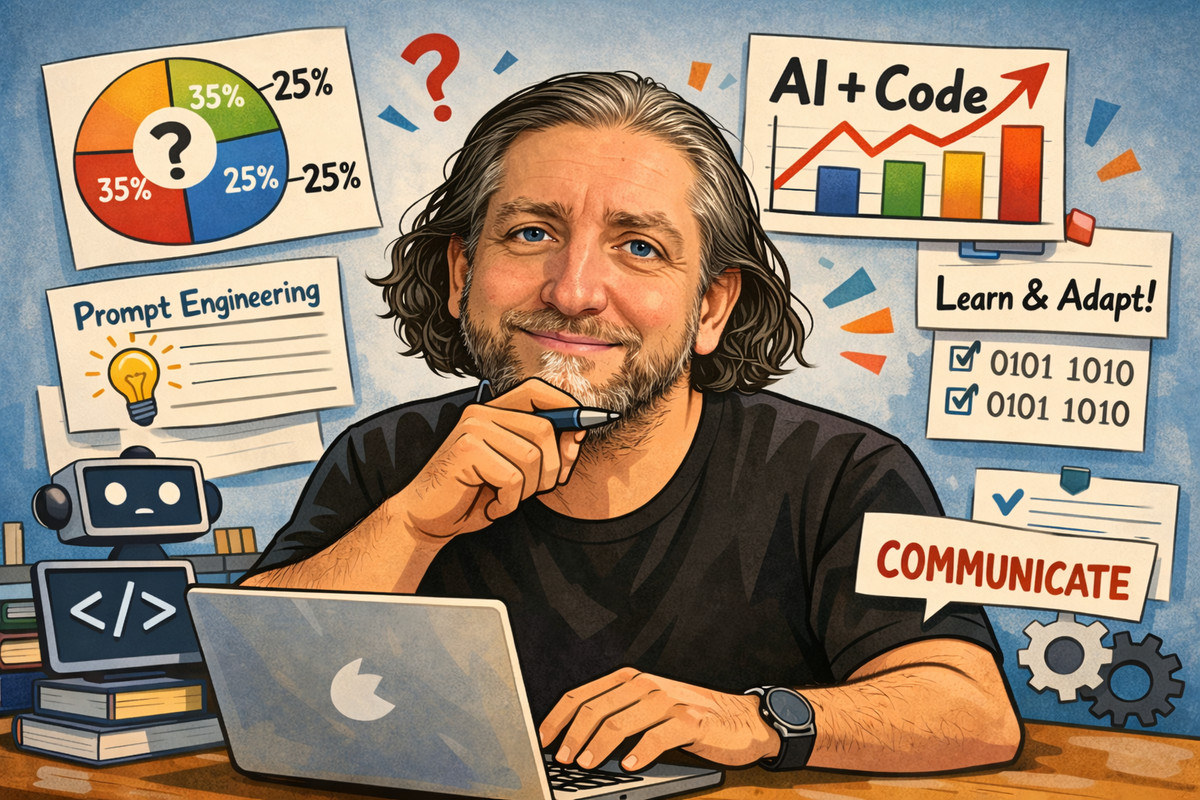
A reflection on AI, collaboration, and what makes a developer irreplaceable
by Brian Pollock
Something significant is happening in software development — and it's moving faster than almost anyone predicted. The tools we use, the workflows we follow, and the skills that make a developer valuable are all shifting at once. AI-assisted development is no longer a novelty or a future concern. It's here, it's capable, and it's changing what it means to be good at this job.
If you're on a development team right now, the question isn't whether AI will affect your role. It's whether you'll be the person who shapes how your team uses it — or the person who gets left behind because they didn't.
Communication Is Now a Core Technical Skill
For a long time, developers could succeed by being excellent at isolated technical execution. Take a ticket, write the code, close the ticket. That model is breaking down.
AI can now handle significant portions of that execution loop — and in some cases, handle them faster and more consistently than a human can. What AI can't do is understand the why behind a request, navigate ambiguity, ask the right follow-up question, or translate a client's vague idea into a coherent implementation plan.
That's where the human developer becomes irreplaceable. The ability to communicate clearly — with project managers, designers, clients, and teammates — is no longer a soft skill that's nice to have. It's a core technical competency.
Developers who ask better questions, surface hidden requirements, and keep all stakeholders aligned are the ones who will provide the most value in an AI-augmented workflow.
Learn to Guide AI, Not Just Use It
There's a meaningful difference between someone who pastes a prompt into a chat window and someone who knows how to engineer that prompt to get a precise, reliable result. As AI takes on more of the mechanical work of software development, prompt fluency is becoming a genuine skill gap on teams.
Effective prompting means being explicit — spelling out not just what you want, but what you don't want. It means providing context, defining constraints, and iterating when the output isn't quite right. It also means knowing when to trust the output and when to push back on it. The developers who will stand out are those who can consistently extract high-quality results from AI tools and integrate those results thoughtfully into a larger system.
This is a skill worth investing in now, before it becomes table stakes.
Architect for AI Collaboration
One practical reality of working with AI tools: they perform better on smaller, well-defined components than on large, tangled codebases. If your team is still working primarily with monolithic architectures, you may be limiting what AI can actually do for you.
Modular design — pulling functionality into isolated libraries, services, and components — isn't just good engineering practice. It's increasingly the foundation for effective AI-assisted development. When AI can focus on a discrete, well-bounded problem, it produces better results. Developers who understand this and advocate for modular architecture are contributing directly to their team's ability to leverage AI effectively.
The same principle applies to testing. Tools that use AI to generate test cases are becoming more capable, and they work best when the code they're testing is clean and modular. Learning tools like Playwright and exploring AI-generated testing approaches is a practical way to stay ahead.
Continuous Learning Is No Longer Optional
In medicine, continuing education isn't a suggestion — it's a professional obligation. The pace of change in AI-assisted development is starting to demand the same mindset from software professionals.
What worked last year may already be a step behind. New models, new tools, and new workflows are emerging constantly. Developers who set aside even a few hours each week to research, experiment, and stay current will compound that investment over time. Those who don't, will find the gap between themselves and the field widening faster than they expect.
Good areas to explore right now include prompt engineering, AI-assisted security analysis (AI can already scan compiled code for vulnerabilities like buffer overflows), AI-generated documentation, and automated testing. The specific tools will keep changing — the habit of learning won't.
Be Visible, Be Engaged
One subtle but important shift: in AI-augmented teams, contribution is increasingly visible across more dimensions than just code output. Slack conversations, ticket engagement, idea sharing, and cross-functional collaboration all signal the kind of active, thinking participation that makes a developer genuinely valuable.
This isn't about performative busyness. It's about showing up as a thinker and contributor — someone who is engaged with the problem, not just processing tasks. Teams that communicate well, stay aligned, and surface insights early will consistently outperform those that don't, regardless of how good their code is.
The Shift Is Already Underway
The developers who will thrive in the next phase of this industry aren't the ones who can write the most code. They're the ones who can think architecturally, communicate clearly, guide AI tools with precision, and keep learning as the landscape evolves.
That combination — human judgment, communication skills, and AI fluency — is what no tool can replace.
The good news is that it's also learnable.
The time to start building those skills is right now.
Originally published on Protovate.AI
Protovate builds practical AI-powered software for complex, real-world environments. Led by Brian Pollack and a global team with more than 30 years of experience, Protovate helps organizations innovate responsibly, improve efficiency, and turn emerging technology into solutions that deliver measurable impact.
Over the decades, the Protovate team has worked with organizations including NASA, Johnson & Johnson, Microsoft, Walmart, Covidien, Singtel, LG, Yahoo, and Lowe’s.
About the Author

Share article


