
IF: The World Switched to "Maybe-nary" Logic
What if computers stopped giving clear answers and started running on “maybe” instead? A funny April Fool’s Day thought experiment about smart devices, uncertain logic, and the most relaxing productivity disaster in history.

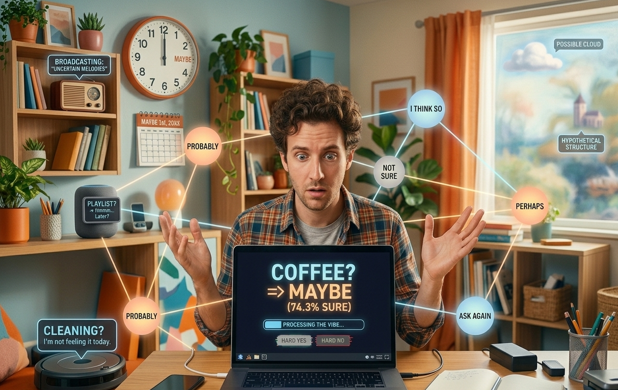
It’s all fun and games until the AI starts using 'Maybe-nary' logic on our productivity essentials (coffee)!
by Eugenio Pello
The Premise
For decades, the digital world has been bossy. It’s binary. It’s 1 or 0. Yes or No. True or False. It’s a rigid system that demands an answer for everything.
But what if the world’s computers decided they were tired of being so certain? What if, in a global software update, the binary "1" and "0" were replaced by a third, much more relaxed option?
Welcome to the era of "Maybe-nary."
The "Maybe" Revolution
In the Maybe-nary world, computers no longer feel pressured to give you a straight answer. Instead of a "Yes" or "No," every piece of technology on Earth now operates on a spectrum of "I’ll think about it," "Possibly," and "I’m not really in the mood."
It’s not a bug. It’s a lifestyle.
Life in the "Maybe" Lane
Imagine waking up in this hypothetical reality. You walk to your kitchen and press the button on your smart coffee maker.
In a binary world, the machine turns on. In a Maybe-nary world, the coffee maker looks at the time, considers the humidity, and displays a polite message: "I’m about 60% sure I want to brew today. Ask me again in ten minutes."
You don't get mad. You can't. The machine isn't broken; it's just exploring its options.
The Social Impact
The "Maybe" logic quickly spreads to every corner of our lives:
- GPS Navigation: Your maps app no longer says "Turn Left." It says, "You could turn left here, or we could see where this dirt road goes? I’m feeling adventurous."
- Online Shopping: You click "Buy Now." The website responds: "Order received. We might ship it. Or we might keep it. It’s a surprise!"
- Smart Locks: You get home and try to unlock your door. The house asks: "Is it really you? You look a bit tired. Let's sleep on it and try again tomorrow."
The New "Vibe" Economy
In the Maybe-nary era, the most successful people aren't the ones with the fastest computers; they are the ones who are the best at negotiating with their devices.
IT departments are replaced by "Digital Therapists." When a server goes down, you don't reboot it—that's considered rude. Instead, you sit in the server room, play some soft jazz, and try to convince the database that it’s a valued member of the team. Once the server "feels seen," it might—just might—decide to process your data.
Conclusion: The Beauty of Uncertainty
If we lived in a Maybe-nary world, nothing would ever be on time, and nothing would ever be certain. We would trade efficiency for a strange, digital kind of freedom.
It’s an absurd scenario. It would be a total disaster for productivity, but honestly? It might be the most relaxing disaster in history. After all, if the computer doesn't know if it's working or not, maybe you don't have to either.
Happy April Fool’s Day. I’d tell you to have a great day, but... well, let's just say it's a "Maybe."
Originally published on Protovate.AI
Protovate builds practical AI-powered software for complex, real-world environments. Led by Brian Pollack and a global team with more than 30 years of experience, Protovate helps organizations innovate responsibly, improve efficiency, and turn emerging technology into solutions that deliver measurable impact.
Over the decades, the Protovate team has worked with organizations including NASA, Johnson & Johnson, Microsoft, Walmart, Covidien, Singtel, LG, Yahoo, and Lowe’s.
About the Author

Share article


