
The Spreadsheet Everyone Was Afraid to Touch
A temporary spreadsheet built to save time became a business-critical system that outlived its creator. A funny story about institutional knowledge hiding in plain sight.

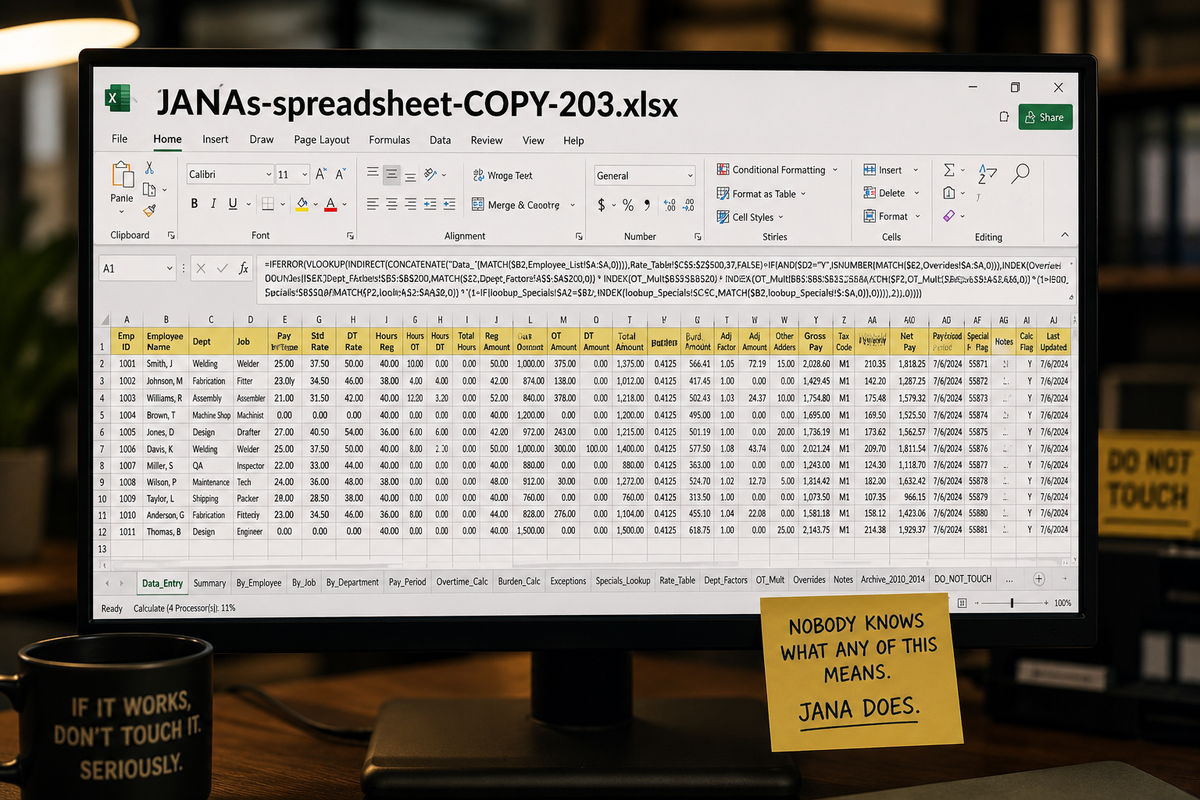
How a lazy shortcut became part of the business
by Jana Diamond, PMP
I have a confession.
I built that spreadsheet.
You know the one.
The one nobody wants to touch.
The one with 19 tabs, formulas that stretch halfway across the screen, and mysterious calculations nobody dares to change.
I built it.
Not because I was trying to revolutionize the company.
Not because I was some Excel genius.
I built it because I was lazy.
It was a temporary job at a welding company. I was only going to be there for a few weeks.
Every Friday I had to total labor hours by employee, by job, by department, by pay period... over and over again.
After doing it a couple of times, I looked at the stack of paperwork and thought...
"Nope. I'm only doing this once."
So I built a spreadsheet.
It worked beautifully.
I'd enter the hours, and voilà! The reports that used to take hours were finished in minutes.
Problem solved.
Or so I thought.
Temporary Has a Funny Definition
I never intended for anyone else to depend on it.
It was just a shortcut to make my job easier while I was there.
Then somebody else started using it.
Then they added another worksheet.
Another report.
Another formula.
Another exception.
I finished my temporary assignment and moved on.
The spreadsheet didn't.
Ten Years Later...
Here's the scary part.
I still get phone calls.
Not every week.
Not every month.
But every so often, my phone rings.
"Hey Jana... do you remember how this formula works?"
Think about that for a second.
I was there for a few weeks.
More than a decade later, part of that company still depends on something I built because I got tired of doing the same paperwork every Friday.
That's both hilarious...
...and a little terrifying.
They Aren't Really Calling About Excel
The funny thing is, they're not actually asking about spreadsheets.
They're asking about the business.
Why is overtime calculated this way?
Why is this department treated differently?
Why doesn't this employee get included in that total?
Those aren't Excel questions.
They're business rules.
When I wrote those formulas, every one of those little exceptions made perfect sense.
I knew why they were there.
Today?
I'd probably have to stare at it for a while too.
Because the spreadsheet wasn't just doing math anymore.
It had quietly become a record of how the company worked.
When Shortcuts Become Infrastructure
This happens in companies all the time.
A spreadsheet.
A script.
A little Access database.
A Power Automate flow somebody built on a Friday afternoon.
None of them started as "enterprise software."
They started because someone got tired of doing the same thing over and over and thought, There has to be an easier way.
The shortcut works.
People trust it.
It quietly becomes part of the business.
Until the day something changes.
Then everyone discovers the most important business rules were never documented.
They were hidden inside a formula.
Nobody meant for that to happen. That's just where the knowledge accumulated.
The Real Asset
I was being my version of lazy.
Sure, it took me a week to put it all together.
But after that, the weekly report was done in minutes instead of hours. It was off my plate.
I even left instructions for how to use it and update it.
What I didn't realize was that I hadn't just automated a report.
I'd automated a piece of the company's institutional knowledge.
Nobody noticed the difference.
Neither did I.
Until the phone started ringing years later.
We spend a lot of time backing up files.
We spend a lot less time backing up understanding.
The spreadsheet was never the valuable part.
The business knowledge hidden inside it was.
I wasn't supposed to be there long enough to build something the company would still be using years later.
But that's how institutional knowledge sneaks into organizations.
One helpful shortcut at a time.
One "temporary" solution at a time.
One Friday afternoon at a time.
The spreadsheet wasn't the system.
It was just where the system learned to hide.
Originally published on Protovate.AI
Protovate builds practical AI-powered software for complex, real-world environments. Led by Brian Pollack and a global team with more than 30 years of experience, Protovate helps organizations innovate responsibly, improve efficiency, and turn emerging technology into solutions that deliver measurable impact.
Over the decades, the Protovate team has worked with organizations including NASA, Johnson & Johnson, Microsoft, Walmart, Covidien, Singtel, LG, Yahoo, and Lowe’s.
About the Author

Share article


