
The Error Moved To The Corner Office
Automation can eliminate some mistakes, but it doesn't eliminate responsibility. Often the errors just move somewhere harder to see - and more expensive to fix.
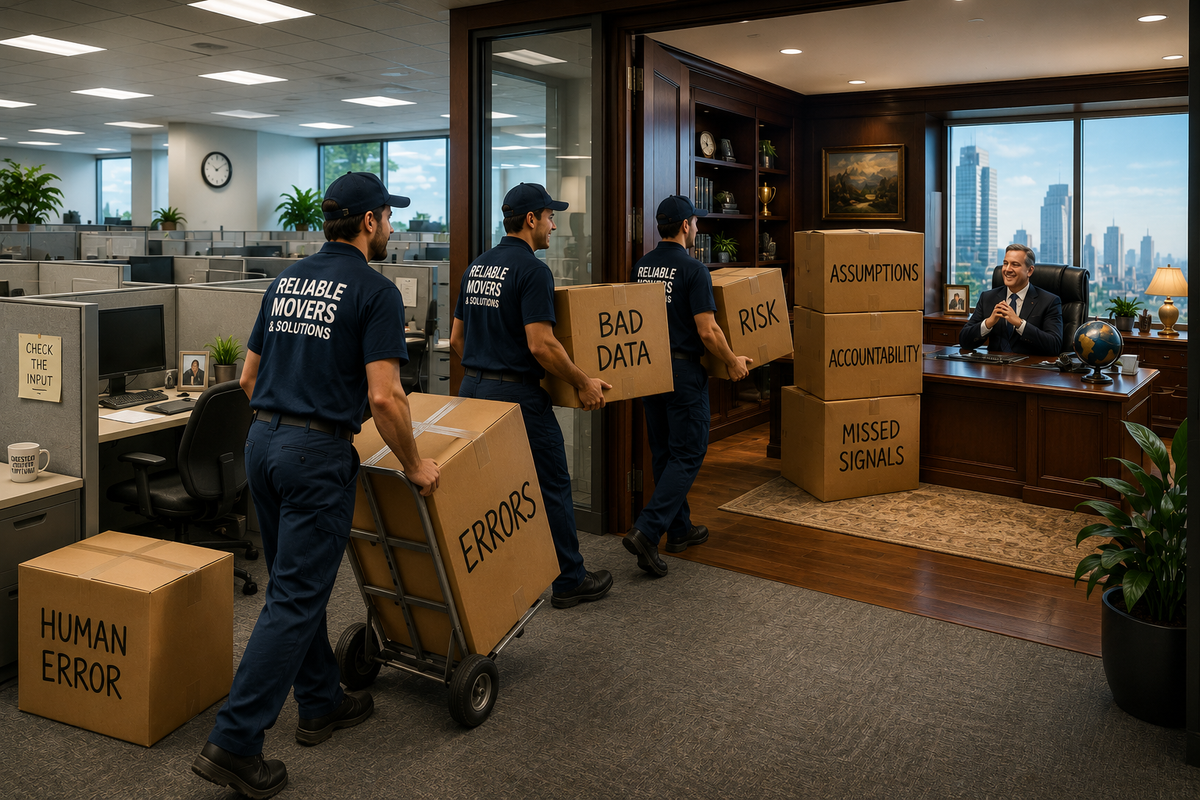
The mistakes didn't disappear. They moved.
by Jana Diamond, PMP
A company rolls out AI because:
- employees make mistakes
- employees forget things
- employees are inconsistent
- employees cost money
The logic seems straightforward.
Reduce the human involvement à reduce the errors.
Fine and dandy.
Except that's not what happens.
The mistakes don't disappear.
They move.
A customer service rep can misread an account.
An AI system can misclassify ten thousand accounts before anybody notices.
A data entry clerk can enter the wrong number.
An automated workflow can propagate the wrong number through six systems before lunch.
Same mistake.
Different scale.
The Human Error Story
For years we've been told that problems happen because people are unreliable.
Maybe.
Sometimes.
But hmmmm . . . let's think about that.
Who designed the process?
Who created the incentives?
Who approved the timeline?
Who decided testing could wait?
Who removed the verification step because it slowed things down?
Human error is real.
But many "human errors" are actually system errors wearing a human name tag.
Where The Mistakes Go
Automation absolutely removes some mistakes.
If a system can automatically transfer data instead of requiring someone to type it twice, that's a good thing.
If software can catch a typo before it reaches a customer, even better.
I'm not arguing that automation doesn't work.
I'm arguing that it changes where the failures happen.
Instead of: A frontline employee enters the wrong number.
You get: A manager approved the wrong model.
Instead of: A customer service rep misclassifies a request.
You get: Nobody noticed the classification system drifting for six months.
The mistake becomes less visible.
Harder to trace.
More expensive.
That's why automation failures often feel so surprising.
The original error may have happened weeks or months earlier.
The consequences just arrive all at once.
The error didn't disappear.
It moved to the corner office.
You Can't Automate Responsibility
The workflow may be automated.
The accountability isn't.
That's the part organizations sometimes miss.
Automation can eliminate certain mistakes.
It can reduce others.
But every automated system is still designed, configured, approved, funded, monitored, and trusted by people.
The mistakes don't disappear.
They take a moving van.
Sometimes to the data.
Sometimes to the model.
Sometimes to the assumptions.
And sometimes all the way to the corner office.
Originally published on Protovate.AI
Protovate builds practical AI-powered software for complex, real-world environments. Led by Brian Pollack and a global team with more than 30 years of experience, Protovate helps organizations innovate responsibly, improve efficiency, and turn emerging technology into solutions that deliver measurable impact.
Over the decades, the Protovate team has worked with organizations including NASA, Johnson & Johnson, Microsoft, Walmart, Covidien, Singtel, LG, Yahoo, and Lowe’s.
About the Author

Share article


