
Copy. Paste. Forget.
AI can now generate answers, workflows, summaries, and code in seconds. The catch? We may be solving problems faster than we’re actually learning from them.
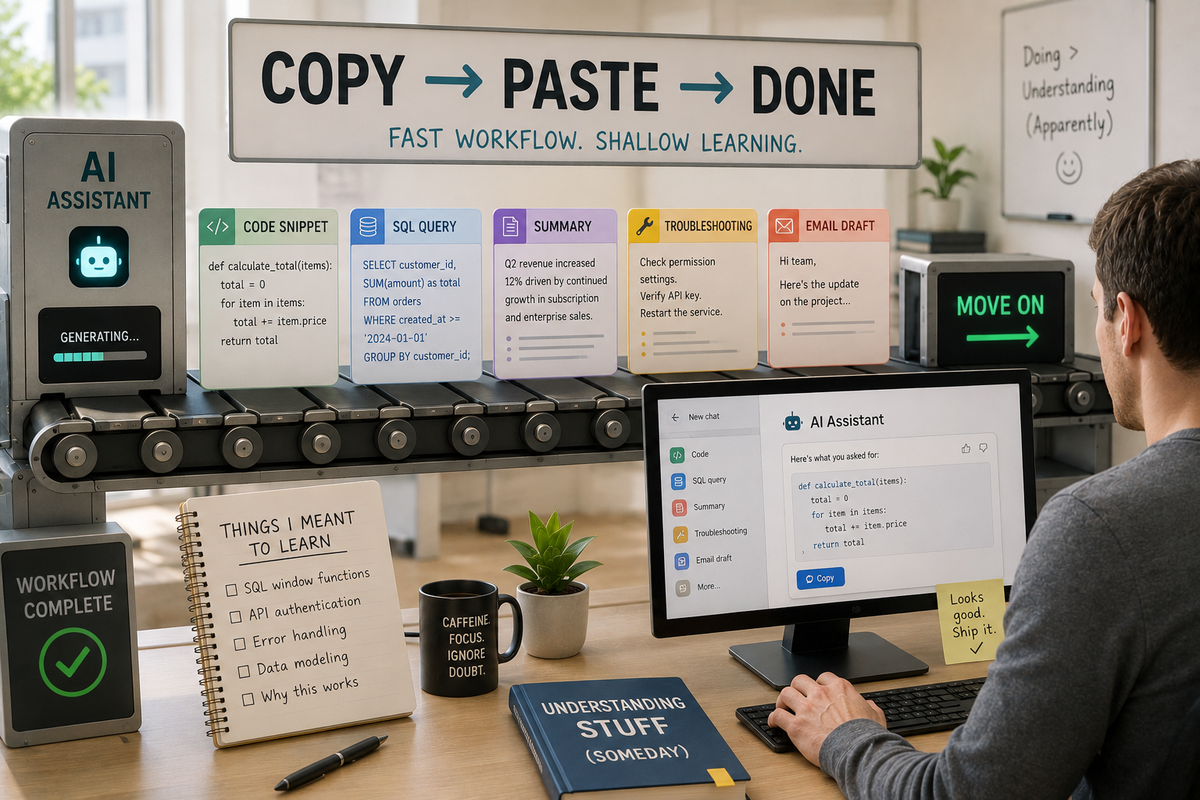
We used to learn things while solving them.
By Jana Diamond, PMP
You probably used to know more phone numbers than you do now.
Not one or two. A lot more.
Your childhood home.
Your best friend.
Your grandmother.
Your spouse.
Maybe the pizza place if you were truly committed to the bit.
Now? Most of us couldn’t tell you our own kid’s number without checking our phones first.
And honestly, that’s perfectly fine.
The phone remembers so we don’t have to.
The Phone Remembered So We Didn’t
I once heard someone ask for the number to 911.
They weren’t joking.
At first, that sounds ridiculous. Until you stop and think about it for a second.
Contact lists live in the phone now.
Nobody dials numbers manually anymore.
The device handles retrieval, so the brain stops prioritizing retention.
That’s not stupidity.
That’s adaptation.
But that same shift is starting to happen somewhere else now.
Not with phone numbers.
With understanding.
In seconds, AI can now generate:
· code
· formulas
· summaries
· workflows
· emails
· slide outlines
· troubleshooting steps
And increasingly, people are solving problems faster than they’re learning from them.
That’s the interesting part.
Not whether the answer was correct.
But whether anything actually stuck afterward.
The Process Still Mattered
Old workflows forced a certain amount of friction.
You searched.
Compared answers.
Read documentation.
Tried things that didn’t work.
Debugged mistakes.
Went down weird rabbit holes written by some total nerd in a 14-year-old forum thread with a blinking GIF signature.
And while that process was annoying . . . it also built mental models.
You remembered things partly because you had to fight with them a little.
We learned from our mistakes; we built those neural nets in our own brains.
AI compresses that process.
Sometimes brilliantly.
You ask a question.
Get a polished answer.
Paste it into the workflow.
Move on with your day.
Spiffy.
The immediate problem gets solved.
But nothing really sticks afterward.
Search engines mostly replaced data retrieval.
But the process still mattered.
You still had to decide what mattered.
You still had to connect the dots.
You still had to work through it yourself.
AI is beginning to compress the process itself.
And that’s different.
And when the workflow breaks - because eventually some workflow always does - the missing understanding suddenly matters again.
We’ve always used technology to extend memory.
That’s not new.
The interesting question is what happens when technology starts replacing not just what we know . . . but how we learn it in the first place.
We used to learn things while solving them.
Increasingly, we’re just renting answers.
Originally published on Protovate.AI
Protovate builds practical AI-powered software for complex, real-world environments. Led by Brian Pollack and a global team with more than 30 years of experience, Protovate helps organizations innovate responsibly, improve efficiency, and turn emerging technology into solutions that deliver measurable impact.
Over the decades, the Protovate team has worked with organizations including NASA, Johnson & Johnson, Microsoft, Walmart, Covidien, Singtel, LG, Yahoo, and Lowe’s.
About the Author

Share article


