
The Resume That Gets The Interview
AI can make resumes better, clearer, and fairer. It can also change what a resume actually measures. And that's where things get interesting.

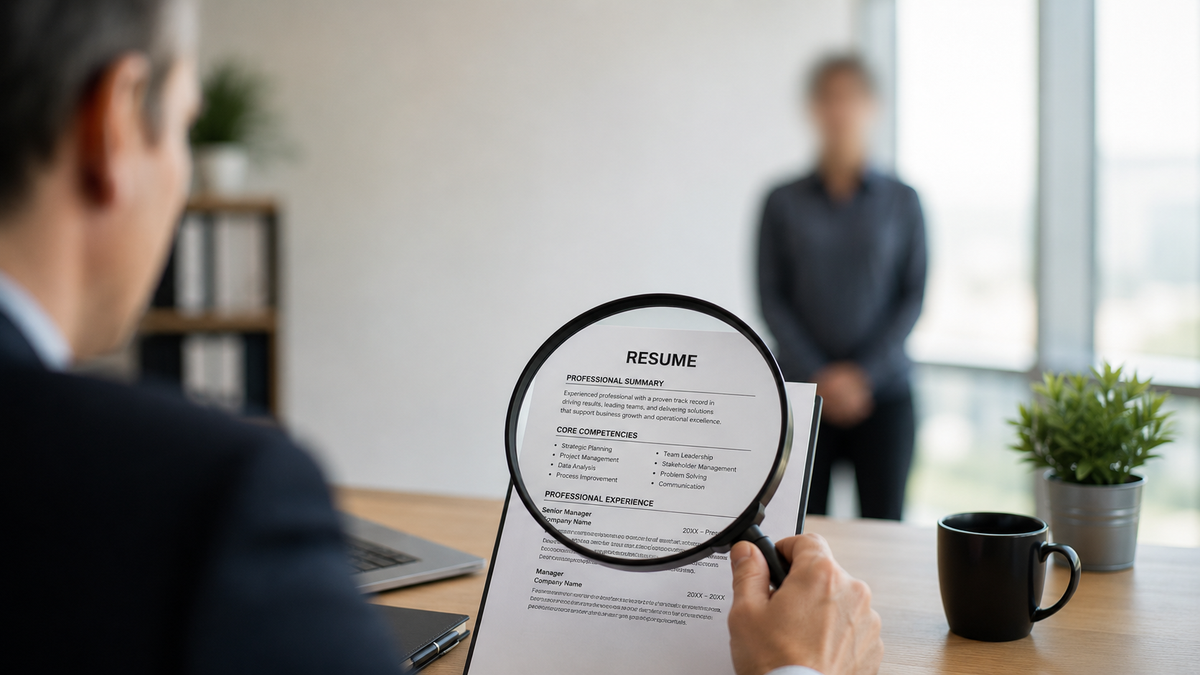
The resume didn't change. The signal did.
by Jana Diamond. PMP
Hiring manager.
Stack of resumes.
One jumps out immediately.
Clean layout.
Strong bullet points.
Great action verbs.
Professional summary sounds polished and confident.
You think:
"Now this candidate has their act together."
Pretty typical, right?
We've been trained to view a polished resume as evidence of professionalism.
Maybe it is.
Maybe it isn't.
Twenty years ago, a well-written resume usually meant one of two things:
The candidate was a strong writer.
Or they paid somebody to help.
Today there's a third possibility.
A chatbot.
And that, my friend, changes what the document actually measures.
What Resumes Used To Signal
A resume has never been a perfect predictor of job performance.
Everybody knows that.
Some people interview brilliantly and perform poorly.
Some people are terrible at selling themselves and turn out to be rock stars.
Still, resumes served a purpose.
They acted as a signal.
Not just of experience, but of communication skills, attention to detail, organization, and professionalism.
A sloppy resume suggested a sloppy candidate.
A thoughtful resume suggested a thoughtful candidate.
Not always.
But often enough that most hiring managers considered it a useful shortcut.
The relationship wasn't perfect.
It was directionally correct.
The Signal Is Changing
Now imagine two candidates.
Candidate A writes their own resume.
It's honest. Accurate. Maybe a little clunky.
Candidate B spends twenty minutes with an AI assistant.
The resulting document is polished.
Every bullet is stronger.
The summary sounds confident.
The wording is crisp.
The accomplishments shine.
Who gets the interview?
Maybe Candidate B deserves it.
Maybe Candidate B is genuinely the stronger candidate.
But that's not really the interesting question.
The interesting question is:
What are you measuring now?
Writing ability?
Professionalism?
Experience?
Attention to detail?
Or something else entirely?
Because AI doesn't just improve resumes.
It changes what a resume represents.
Maybe That's Not Entirely Bad
At first glance, this seems like a problem.
If AI can make almost anyone sound polished, doesn't that make resumes less useful?
Maybe.
But . . . maybe not.
Traditional resumes weren't measuring only experience.
They were also measuring writing ability, confidence, familiarity with professional norms, access to coaching, and a dozen other factors that had little to do with the job itself.
Consider two candidates with identical accomplishments.
One describes her work accurately, but conservatively:
Managed project meetings and coordinated schedules.
The other writes:
Led strategic cross-functional initiatives across diverse stakeholder groups.
Same work.
Different presentation.
And presentation matters.
Research has repeatedly shown that people don't all describe their accomplishments the same way.
Some of us have been trained to downplay ourselves.
Others have been trained to sell, sell, sell.
That comes through in resumes.
AI may actually narrow some of those differences.
A candidate who struggles to articulate their accomplishments can use AI to present them more clearly.
That's not necessarily deception.
Sometimes it's translation.
When Evidence Changes Meaning
This happens every time technology removes effort from a process.
Spell-check changed what spelling mistakes meant.
GPS changed what navigation skills mattered.
Calculators changed what mental arithmetic measured.
The artifact remains.
The meaning shifts.
If AI helps everyone sound more polished, then polish becomes less informative.
The signal doesn't disappear.
It changes.
A polished resume may tell us less about writing ability than it did ten years ago.
It may tell us less about confidence.
It may even reduce some long-standing biases tied to communication style.
That's a good thing.
But it also means hiring managers need to be more careful about what conclusions they're drawing from the document.
Because the resume may no longer be measuring what they think it's measuring.
The Resume Didn't Change. The Signal Did.
It's tempting to look at AI-written resumes and conclude that the whole system is broken.
I'm not buying that.
Resumes have never been perfect measures of talent. They were always influenced by writing ability, confidence, coaching, education, professional networks, and familiarity with professional norms.
AI may actually improve some of that.
Someone who struggles to describe their accomplishments can present them more clearly. Someone who habitually undersells themselves can communicate their value more effectively. In some cases, that may level a playing field that wasn't particularly level to begin with.
That's a real benefit.
But it doesn't eliminate the underlying issue.
It changes it.
A polished resume used to tell us something about the candidate's writing ability.
Today it might tell us something about their ability to use AI.
Or their willingness to use it.
Or simply their access to better tools.
The resume still contains information.
The challenge is understanding what information it's actually providing.
That's the part that matters.
Because whenever technology changes how something is created, it changes how that thing should be interpreted.
The resume didn't disappear.
The signal changed.
The question isn't whether candidates should use AI.
They're going to.
The question is whether hiring managers still understand what a resume is measuring.
Originally published on Protovate.AI
Protovate builds practical AI-powered software for complex, real-world environments. Led by Brian Pollack and a global team with more than 30 years of experience, Protovate helps organizations innovate responsibly, improve efficiency, and turn emerging technology into solutions that deliver measurable impact.
Over the decades, the Protovate team has worked with organizations including NASA, Johnson & Johnson, Microsoft, Walmart, Covidien, Singtel, LG, Yahoo, and Lowe’s.
About the Author

Share article


