
The Worm Emperor Problem
Many people imagine AI as a giant hive mind that learns from every interaction. The reality is far less dramatic—and understanding the difference matters.
Why Enterprise AI Isn't a Hive Mind
by Jana Diamond, PMP
One reason people get confused about AI is that they imagine it works like a giant collective brain.
You ask a question.
The AI learns from it.
The next person asks a question.
The AI learns from that too.
Over time, every conversation feeds a single enormous machine that remembers everything forever.
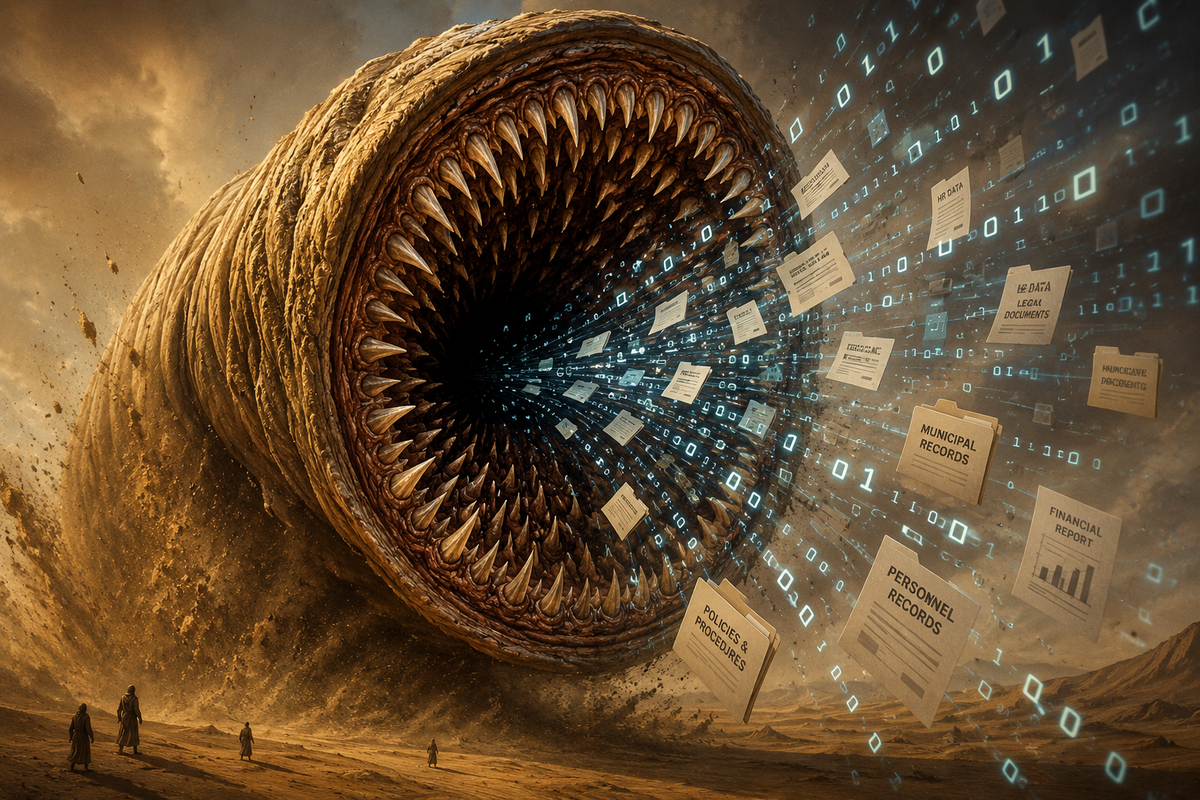
In science fiction terms, people imagine something like the God Emperor from Dune.
A vast intelligence absorbing knowledge from across humanity.
It's a funny image. I've joked for years about being the "God-Emperor of the Universe" whenever someone starts acting like they know everything.
It's also the source of a lot of legitimate concerns.
When organizations evaluate AI systems, they're often asking some version of the same question:
"If we put our information into this thing, where does it go?"
The concern isn't irrational.
If you're responsible for personnel records, financial reports, healthcare data, legal documents, or municipal records, you should care what happens to that information.
The problem is that people often mix together two very different concepts:
Processing data and training models.
To answer a question, an AI system has to process the information you provide.
That's how it generates a response.
Training is something else entirely.
Training means using that information to improve future versions of the model.
Those are not the same activity.
Unfortunately, public discussions about AI often treat them as if they are.
People sometimes imagine a giant digital hive mind where every document, every prompt, and every conversation becomes permanent nourishment for the machine.
AI isn't the Worm Emperor.
It isn't the Hive Queen, either.
The reality is usually much less dramatic.
Most enterprise AI deployments are designed specifically to prevent customer information from becoming part of future model training.
Organizations don't want their data absorbed by the Worm Emperor.
They don't want it joining the Hive, either.
They want to answer questions about policies, summarize documents, automate workflows, and help employees get work done.
Nothing more.
People want to know:
- Who owns the data?
- Who can access it?
- How long is it retained?
- Is it used for training?
- Can it be deleted?
Those questions are far more important than whether a model has another decimal place of accuracy.
Because trust isn't built by intelligence alone.
It's built by understanding what happens to information after you press Enter.
The technology may be sophisticated.
The governance questions are not.
Originally published on Protovate.AI
Protovate builds practical AI-powered software for complex, real-world environments. Led by Brian Pollack and a global team with more than 30 years of experience, Protovate helps organizations innovate responsibly, improve efficiency, and turn emerging technology into solutions that deliver measurable impact.
Over the decades, the Protovate team has worked with organizations including NASA, Johnson & Johnson, Microsoft, Walmart, Covidien, Singtel, LG, Yahoo, and Lowe’s.
About the Author

Share article


