
The Chatbot Ate My Scenes
AI helped me start writing a book. Then it quietly buried the actual writing under scene cards, summaries, rewrites, and endless almost-progress. A look at how AI can create the feeling of momentum without helping you finish.

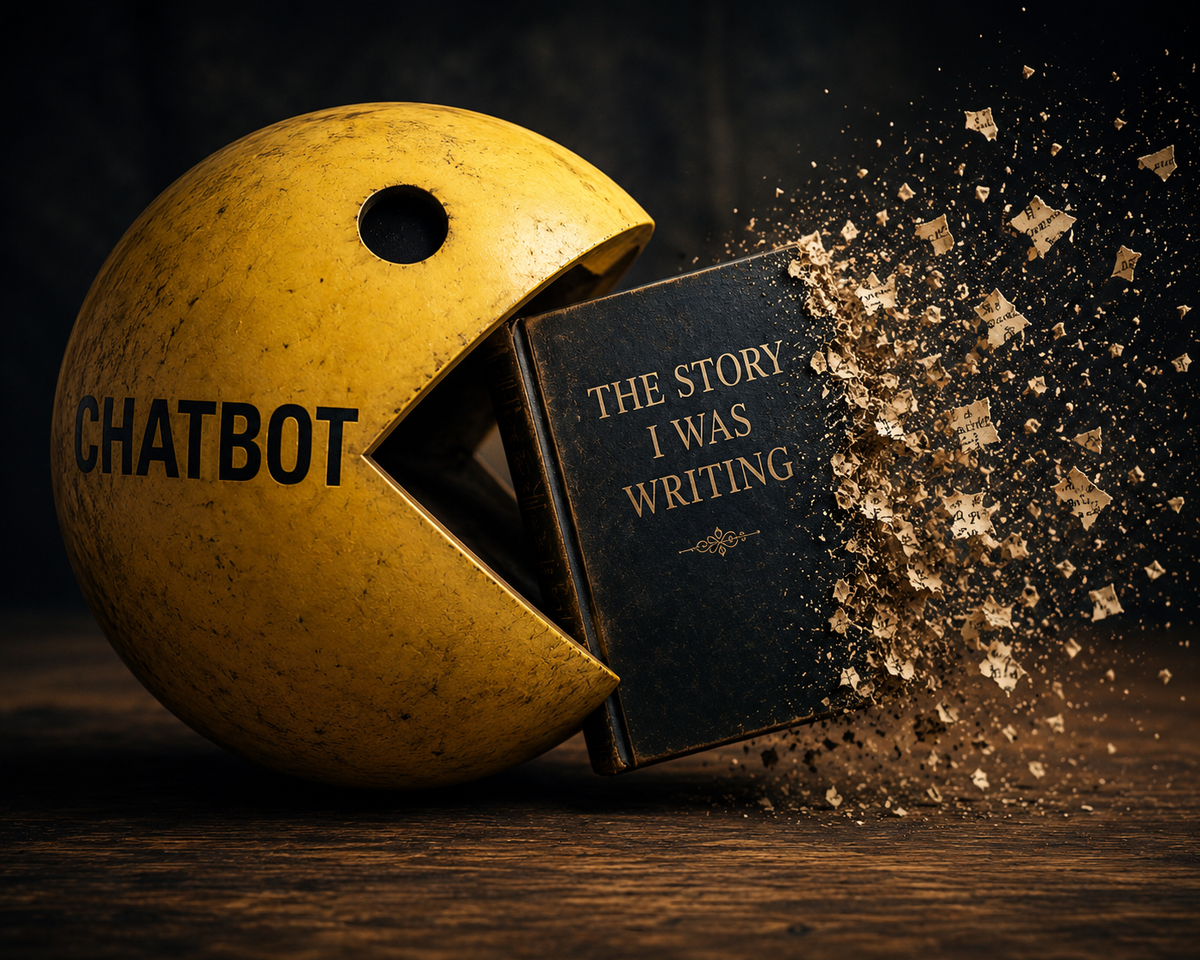
How AI turned writing into an infinite loop of scene cards, summaries, and almost-progress
by Jana Diamond, PMP
The Book That Wouldn’t Move Forward
A while back, I decided to start writing a book.
Not “someday.”
Actually start.
And AI turned out to be incredible for getting momentum going.
I could write a rough scene and toss it into the chatbot. Back would come:
- scene cards
- structure ideas
- emotional beats
- continuity notes
- chapter placement suggestions
- alternate phrasings
- possible callbacks
- character observations
Honestly? It was amazing.
It felt like having an infinitely patient brainstorming partner sitting next to me 24/7.
I’d write one scene . . .
and suddenly the system gave me twelve more directions to explore.
So I explored them.
And then explored the revisions to those.
And then the revised scene cards.
And then alternate versions of the scenes.
And then restructured chapter flows.
And then possible thematic groupings.
The Work Around the Work
And somewhere in there, something weird happened.
I stopped actually writing the book.
I was still producing words.
Still generating material.
Still “working on it” every day.
But the manuscript itself wasn’t moving forward anymore.
The process had quietly shifted from:
writing the book
to:
managing infinite possibilities about the book.
That’s a very different activity.
And then here’s where it gets weird.
Every actual scene I had written disappeared entirely.
Gone. Poof!
Buried under regenerated versions, revised scene cards, alternate structures, expanded outlines, continuity passes, and “improved” rewrites.
If I hadn’t manually saved the original somewhere outside the chat?
The chatbot ate them all.
Not replaced with a better scene.
Not expanded into a stronger version.
Just . . . flattened into metadata.
A “scene card.”
A synopsis.
Notes about emotional themes.
Suggestions about where the scene belonged structurally.
Thoughts about how it connected to the larger narrative universe.
But the actual writing?
Gone.
That’s a strange thing to realize while supposedly “working on a book.”
I had more material than ever.
More notes.
More analysis.
More structure.
More possibilities.
But less actual book.
The system was helping me produce an ecosystem around the writing faster than I was producing the writing itself.
And that’s when I finally realized what had happened.
The AI had quietly converted authored work into organizational artifacts about the work.
Scene cards.
Continuity notes.
Structural analysis.
Narrative summaries.
Thematic groupings.
Everything surrounding the writing.
Except the writing itself.
That’s the hidden trap.
And because all of it felt productive, it took me a long time to notice the difference.
Three weeks, to be exact.
The Productivity Mirage
Here’s the sneaky part:
It never felt unproductive.
That’s why this catches people.
Every session produced output.
Interesting output.
Useful output, even.
The system kept handing me shiny new threads to pull.
And because AI makes iteration almost frictionless, there was never a natural stopping point.
Before AI, rewriting something took enough effort that eventually you’d say:
“Good enough. Moving on.”
Now?
You can regenerate forever.
The machine always has another suggestion.
Another angle.
Another variation.
Another “what if.”
Three weeks disappeared that way.
Not because I was lazy.
Not because the tool was bad.
Because the system made exploration feel indistinguishable from progress.
The Difference Between Motion and Advancement
That’s the real catch with AI-assisted work.
The tools are phenomenal at helping people begin.
But finishing requires constraint.
It requires deciding:
- this version wins
- this scene stays
- this draft ships
- this path is the path
- I’m doing this my way
For me, that last one was the key. I had to tell it, enough is enough.
AI is optimized for expansion.
Completion requires reduction.
Those are opposing forces.
And if you’re not careful, the system keeps widening the possibility space faster than you collapse it into decisions.
You feel productive the entire time.
But that book?
It never gets to Chapter 2, much less to “The End.”
Originally published on Protovate.AI
Protovate builds practical AI-powered software for complex, real-world environments. Led by Brian Pollack and a global team with more than 30 years of experience, Protovate helps organizations innovate responsibly, improve efficiency, and turn emerging technology into solutions that deliver measurable impact.
Over the decades, the Protovate team has worked with organizations including NASA, Johnson & Johnson, Microsoft, Walmart, Covidien, Singtel, LG, Yahoo, and Lowe’s.
About the Author

Share article


