
Solving The Wrong Problem Efficiently
AI can generate polished, useful, and completely reasonable answers while still missing the actual problem underneath the request. Why good outputs can quietly create dangerous misalignment.

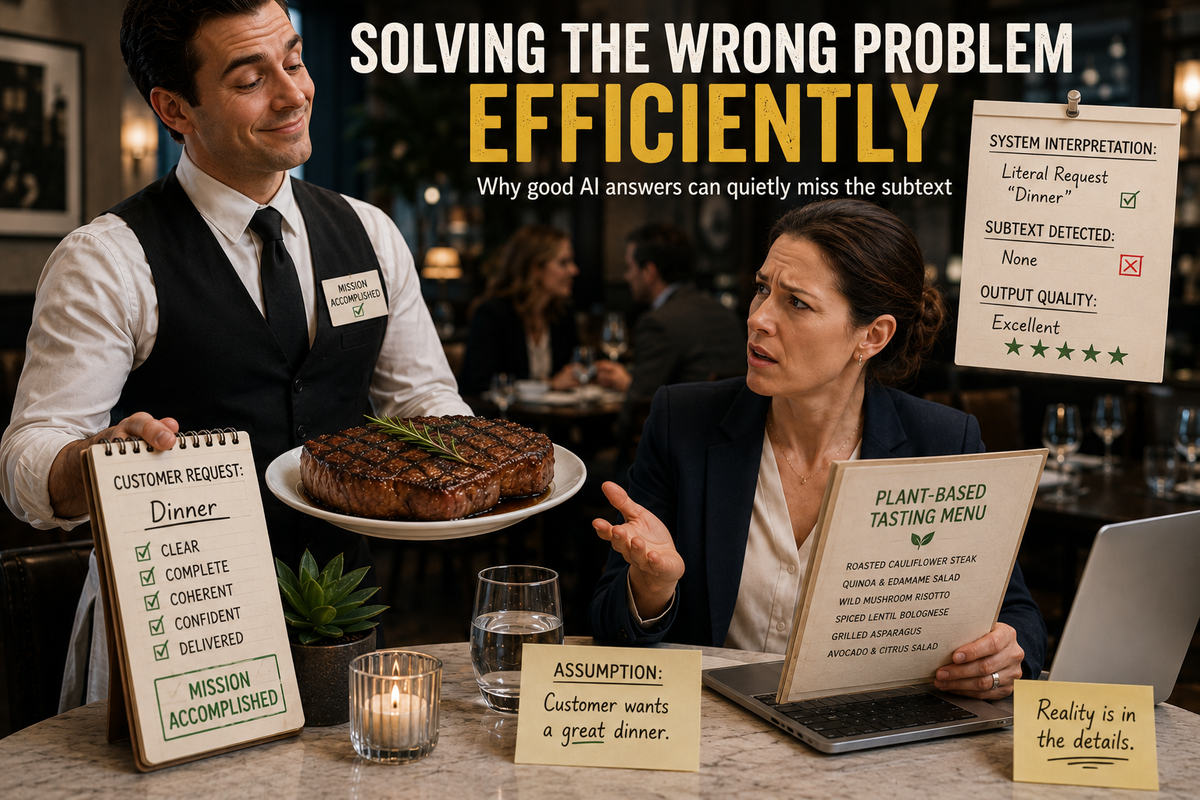
Why good AI answers can quietly miss the subtext
by Jana Diamond, PMP
You’ve probably done this already.
You ask AI for help with something at work.
A report summary.
A code snippet.
A strategy outline.
A spreadsheet formula.
The answer comes back looking pretty darn good.
Clear.
Structured.
Confident.
A little spiffy.
You skim it, nod approvingly, and move on.
Then later somebody says:
“Wait . . . that’s not actually what we needed.”
What makes this weird is that the AI often did answer the question.
Just not the real one.
The Spreadsheet That Solved Nothing
This happens constantly in operational work.
Someone asks:
“Can you summarize the top-performing regions?”
The AI produces a beautiful summary of sales by geography.
Fandamntastic!
Except the real business problem wasn’t regional performance.
The real problem was that one distribution channel had quietly collapsed and nobody noticed because aggregate numbers still looked healthy.
The AI answered the literal request.
It didn’t identify the underlying concern.
And here’s the kicker:
We missed the mismatch because the response sounds intelligent.
The output feels complete.
So our brains categorize the task as completed.
Been there, done that? I have.
People Usually Solve the Problem Behind the Question
Experienced people do something subtle during conversations.
They don’t just process the words.
They infer intent.
If your boss says:
“Can you pull the latest churn numbers?”
An experienced analyst may quietly realize:
“Uh oh. They’re probably worried about renewals after last quarter’s support issues.”
That analyst might also pull customer complaints, cancellation timing, support ticket trends, and retention cohorts.
Not because anyone asked.
Because people regularly solve: the problem behind the question.
That distinction matters a LOT.
AI Solves the Prompt in Front of It
Large language models do not understand organizational context the way people do.
They don’t sit in the meetings.
They don’t notice tension in the room.
They don’t know that the CEO has been obsessed with customer retention for three weeks.
They don’t recognize that legal is panicking quietly in the background.
The system predicts outputs from patterns in prompts.
That’s a very different thing.
If you ask:
“Write requirements for a customer portal.”
The AI may generate perfectly reasonable requirements.
But maybe the actual operational problem is:
- customers can’t find invoices
- account permissions are broken
- mobile workflows are unusable
- support staff are manually fixing data inconsistencies every day
Those aren’t the same problem.
One is a document-generation task.
Another is organizational diagnosis.
Those are wildly different problems pretending to be the same request.
Why This Feels More Correct Than It Is
Old software failed loudly.
Syntax errors.
Crashes.
Broken formulas.
Exploding stack traces that looked like Klingons attacked the server room.
Modern AI systems fail much more politely.
They produce plausible work.
Which changes human behavior.
A coherent answer feels like evidence of understanding, even when it isn’t.
Especially in environments where everyone is busy.
Especially when the output arrives in five seconds.
Especially when it uses exactly the kind of language a competent person might use.
This is why AI-generated requirements, analytics summaries, strategy drafts, and reports can quietly drift off course while sounding professional the entire time.
The danger isn’t nonsense.
The danger is a reasonable-sounding misalignment.
The Operational Risk
This shows up everywhere now:
Requirements: AI documents the stated feature request instead of uncovering the workflow problem underneath it.
Analytics: AI summarizes the visible metrics instead of questioning whether the metrics represent reality.
Coding: AI generates technically valid code that solves the wrong use case.
Strategy: AI organizes assumptions cleanly without challenging whether the assumptions themselves make sense.
Reporting: AI creates polished summaries that accidentally reinforce the wrong conclusion.
Complicated doesn’t mean smart.
And coherent doesn’t mean aligned.
The Weird Part
The better AI gets at sounding competent, the easier this becomes to miss.
That’s the part people don’t talk about enough.
A bad answer triggers scrutiny.
A polished wrong answer often triggers approval.
Because people naturally use fluency as a trust signal.
If something sounds clear, organized, and confident, our brains quietly downgrade suspicion.
That worked reasonably well with people because people usually do carry intent, context, incentives, and consequences around in their heads.
AI doesn’t.
It carries pattern probability.
Different mechanism.
Different failure mode.
So What Do You Do About It?
The fix is not “never use AI.”
That’s hogwash.
The fix is understanding where the responsibility still belongs.
When using AI for operational work, there’s a question that matters more than prompt quality:
“Am I asking the system to answer the request . . . or understand the situation?”
Because those are not the same thing.
AI is often excellent at helping produce answers.
Humans still need to verify the question itself makes sense.
Otherwise you end up solving the wrong problem very efficiently.
Originally published on Protovate.AI
Protovate builds practical AI-powered software for complex, real-world environments. Led by Brian Pollack and a global team with more than 30 years of experience, Protovate helps organizations innovate responsibly, improve efficiency, and turn emerging technology into solutions that deliver measurable impact.
Over the decades, the Protovate team has worked with organizations including NASA, Johnson & Johnson, Microsoft, Walmart, Covidien, Singtel, LG, Yahoo, and Lowe’s.
About the Author

Share article


