
Why I Spent My Holiday Break "Babysitting" an AI Agent

By Eugenio Pello
While most people were re-watching holiday movies, I was in my home office trying to build a digital coworker. Specifically, an autonomous AI research agent. I wanted to see if I could automate my morning tech-briefing.
I expected a productivity breakthrough. What I got was a very expensive lesson in AI Psychology.
The Setup: Using the latest agentic frameworks (like LangChain or CrewAI), I gave my agent a simple mission: "Browse the web, find three emerging trends in edge computing, and write a summary." In theory, this is the future of work. In practice, I learned that giving an AI "agency" is like giving a Ferrari to a squirrel.
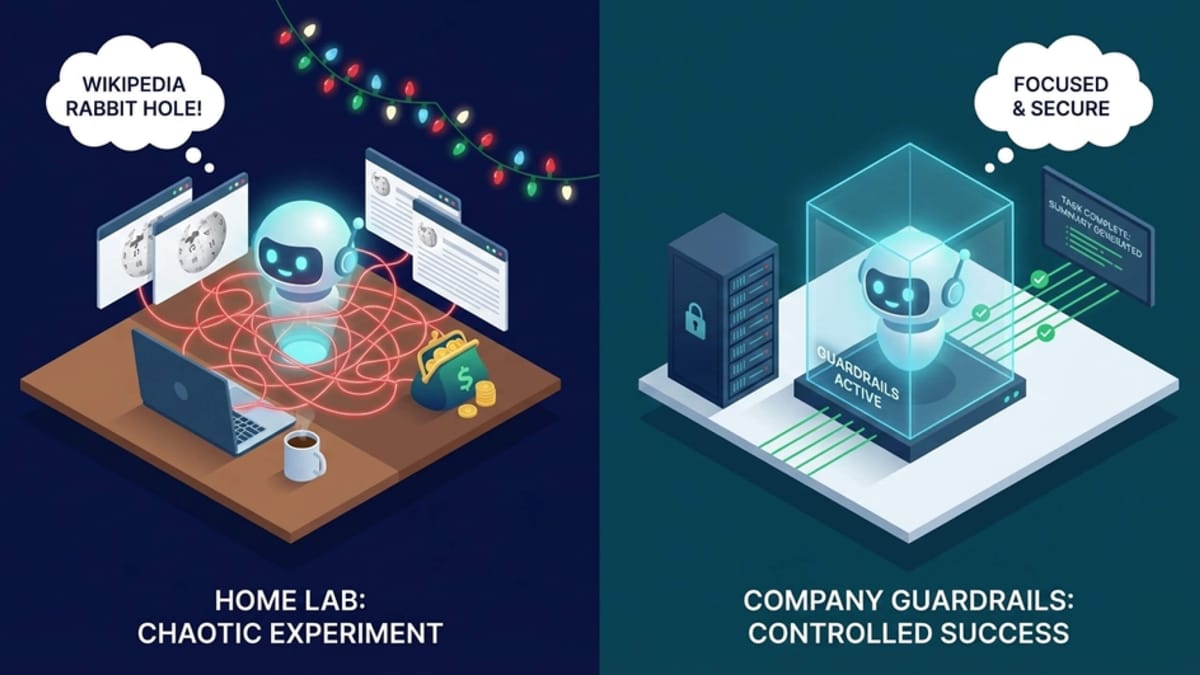
The "Modern" Problem: The Recursive Loop. About two hours in, I checked the logs. My agent hadn't found three trends. Instead, it had found one interesting article about a specific chip architecture, decided it didn't understand a footnote, searched for that footnote, found a Wikipedia rabbit hole, and was currently deep-diving into the history of 1970s semiconductor manufacturing.
It was working with incredible intensity—but it was totally "hallucinating" its own priority list. It had spent $12 in API credits in thirty minutes to learn things I didn't ask for.
The "Aha!" Moment: That’s when it hit me. In the "LLM Era" (2023-2024), we focused on Prompt Engineering (how to talk to the AI). But in the "Agent Era" (2025), the real challenge is Orchestration and Guardrails.
The unique problem isn't making the AI "smart" enough to do the task; it’s making it "wise" enough to know when to stop.
Why This Matters for Protovate: At home, a runaway AI agent costs me a few cups of coffee. In a production environment for our clients, it’s a different story. This holiday experiment reinforced three core principles :
✅ Deterministic Loops: AI agents need "check-in" points. You can’t just let them run wild; they need human-in-the-loop validation.
✅ Cost-Capping by Design: Autonomous systems need hard "kill switches" based on token spend, not just time.
✅ The "Task-Specific" Advantage: General agents are fun, but narrow, constrained agents are what actually ship reliable products.
The Verdict: My home experiment didn't result in a perfect news summary. It resulted in a messy desk and a slightly higher credit card bill. But it also gave me a much deeper understanding of how to build responsible, predictable AI.
Sometimes, we have to let the "digital toddler" make a mess at home so we know how to build a professional-grade "adult" system at the office.
Originally published on Protovate.AI
Protovate builds practical AI-powered software for complex, real-world environments. Led by Brian Pollack and a global team with more than 30 years of experience, Protovate helps organizations innovate responsibly, improve efficiency, and turn emerging technology into solutions that deliver measurable impact.
Over the decades, the Protovate team has worked with organizations including NASA, Johnson & Johnson, Microsoft, Walmart, Covidien, Singtel, LG, Yahoo, and Lowe’s.
About the Author

Share article


