
The Job AI Should Not Have
Why responsible AI systems support human decisions instead of replacing them — and why that distinction matters.
By Jana Diamond, PMP
You’re driving along, and the GPS tells you to turn left.
Into a lake.
Do you turn left?
Of course not! You look up, see the water and ignore the GPS. The GPS suggested, but you made the decision.
That’s because a GPS serves as a decision support system. You, after all, are still the decision maker.
At its core, this small distinction is the source of so many misunderstandings about AI today.
Decision Support vs Decision Making
Decision Support:
The system produces information which a human evaluates.
Decision Making:
The system performs an action without human intervention.
The difference looks subtle, but operationally it is enormous.
|
Decision
Support |
Decision
Making |
|
Provides recommendations |
Executes
Actions |
|
Human accountable |
System
operationally accountable |
|
Assists
judgment |
Replaces
judgment |
|
Example: credit
score |
Example:
automatic loan denial |
One provides an assistant with a degree of autonomy.
The other becomes the job.
What Decision Support Looks Like
This is the scope of many of the systems we trust already. They help people notice potential risks or trends they might otherwise miss:
· Highlighting abnormal lab values
· Suggesting eligible study participants
· Flagging possible drug interactions
· Summarizing patient notes
In each case the system doesn't do what might need to be done.
A human reviews the results. A human decides the action that needs to happen next.
Such systems enhance human skill and expertise. They don't replace it.
What Decision Making Looks Like
Decision-making systems move beyond informing a human, and begin performing actions:
· Automatically enrolling a participant
· Denying treatment coverage
· Issuing a diagnosis without clinician review
· Changing medication dosage automatically
Some automated actions can be appropriate in controlled situations, such as the first two. Others, such as the second two, may be appropriate or may be dangerous depending on context, data quality, or even the ruleset.
The key principle is simple:
The more autonomy a system has, the more oversight it requires.
Why the Human Matters
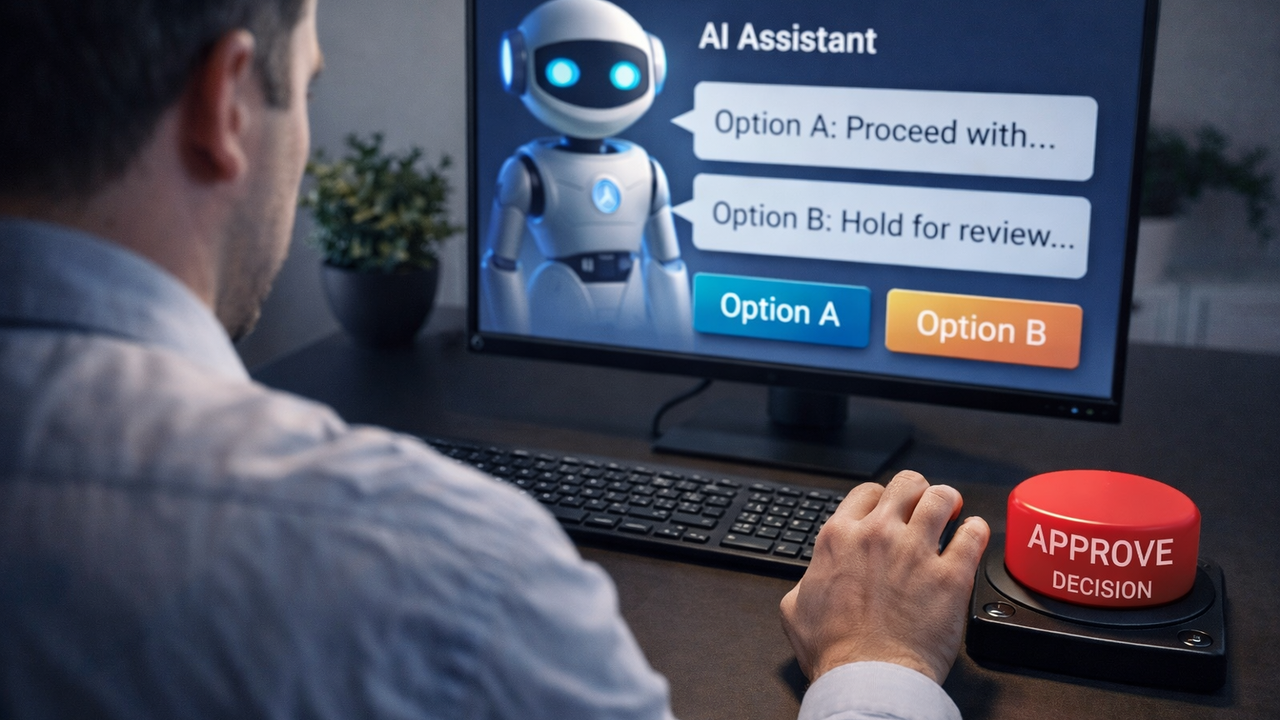
Keeping a human “in the loop” is often seen as a limitation of AI. It is not.
It is a safety feature. A sanity check, if you will.
Humans provide context, ethical judgment, and common-sense checks that automated systems just can’t reliably reproduce. A system may operate exactly as designed and still produce an inappropriate outcome because reality rarely – if ever! – matches training data perfectly.
Poor decisions — whether made by humans or machines — create legal exposure, ethical exposure, and most importantly, a loss of trust.
And trust, once lost, is difficult to recover.
The Real Risk: Automation Bias
The problem isn’t simply that AI makes mistakes.
It is that people have automation bias.
Once we – humans – see a process start to work, most of the time, we assume that it is fool-proof and works all the time. In other words:
When a system is right 95% of the time, we stop checking the other 5%.
And that final 5% is often where the serious consequences live.
Decision-support systems become dangerous when people stop behaving like decision makers.
Why Organizations Prefer Decision Support
Many companies intentionally keep AI in decision support roles rather than decision-making roles. This isn’t because the technology is weak. It is because responsible deployment requires control. This:
· Preserves human accountability
· Reduces regulatory risk
· Allows auditing
· Builds user trust, and
· Promotes learning and improvement
Using AI for decision support allows organizations to benefit from it, without surrendering responsibility.
The Real Goal of Responsible AI
Responsible AI does not aim to remove humans from decisions.
It aims to improve the quality of the decisions humans make.
AI is extremely effective at identifying patterns, surfacing information, and prioritizing attention. Humans remain better at judgment, context, and responsibility.
The goal is not to replace expertise.
The goal is to augment it.
Because the job AI should not have…
is being the one ultimately accountable.
Originally published on Protovate.AI
Protovate builds practical AI-powered software for complex, real-world environments. Led by Brian Pollack and a global team with more than 30 years of experience, Protovate helps organizations innovate responsibly, improve efficiency, and turn emerging technology into solutions that deliver measurable impact.
Over the decades, the Protovate team has worked with organizations including NASA, Johnson & Johnson, Microsoft, Walmart, Covidien, Singtel, LG, Yahoo, and Lowe’s.
About the Author

Share article


