
The Core Challenge Can Be the Governance Debt

By Eugenio Pello
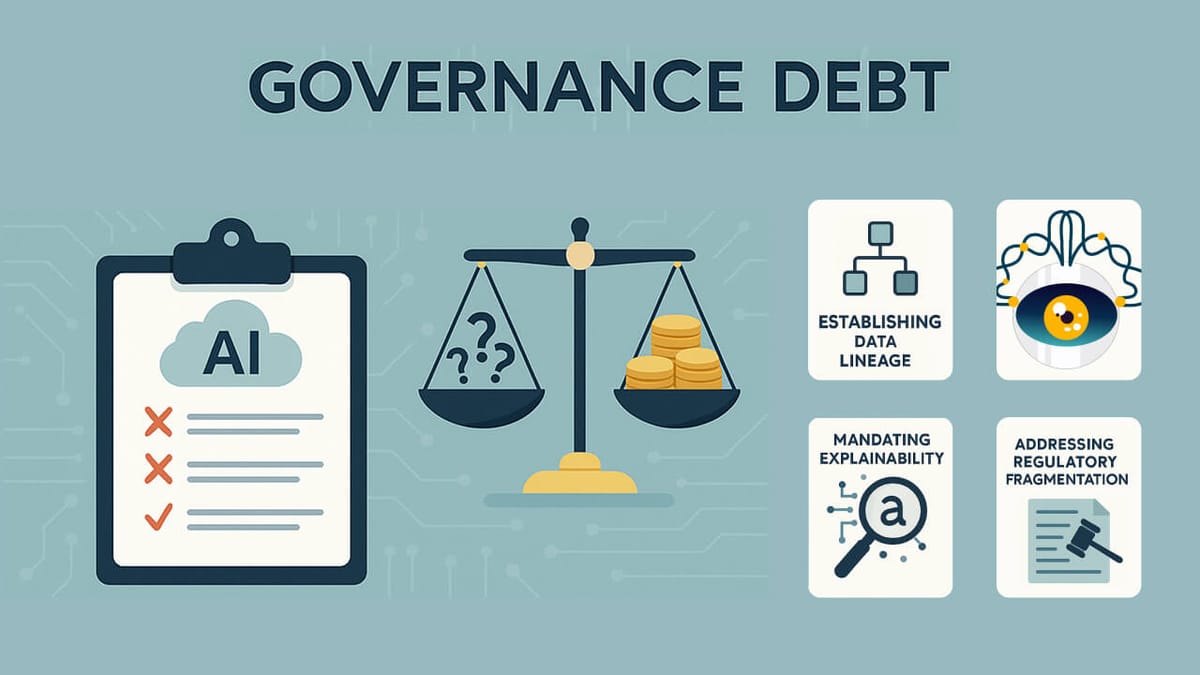
Many organizations accrue "governance debt" by prioritizing speed-to-market over responsible deployment. This manifests as models operating as black boxes without verifiable data provenance, explainability, or fairness audits. To establish Protovate as a thought leader and trusted partner, we must proactively address this debt by:
- Mandating Explainability (XAI): Moving beyond basic performance metrics to requiring verifiable explanations (e.g., using SHAP/LIME methodologies) for high-impact decisions, ensuring models can be justified to clients and regulators.
- Establishing Data Lineage and Provenance: Instituting clear mechanisms to track training data back to its source, certifying its quality, bias profile, and compliance status before training commences.
- Addressing Regulatory Fragmentation: Preparing for emerging mandates (like the EU AI Act) by classifying AI systems based on Risk Tiers (Unacceptable, High, Limited, Minimal) and applying commensurate control requirements.
I would like to elaborate on my views on the Mandating Explainability (XAI) part.
Mandating Explainability (XAI): The Technical Keystone of Algorithmic AccountabilityExplainable AI (XAI) refers to the set of methodologies that make the output and decision-making process of machine learning models understandable to human users. For Protovate, mandating XAI is a strategic move that addresses the core regulatory and ethical challenges associated with "black box" models, particularly in high-risk applications.
1. The Necessity: Mitigation of Algorithmic Risk
In high-stakes domains (e.g., finance, healthcare, legal tech), a model's mere predictive accuracy is insufficient. Compliance frameworks like the EU AI Act and established principles of due process demand a "right to explanation."Legal/Compliance Risk: Without XAI, we cannot demonstrate why a model made a detrimental decision (e.g., loan denial, insurance rate increase). This leaves Protovate and our clients vulnerable to non-compliance penalties and litigation based on discriminatory outcomes. Operational Risk: XAI plays a crucial role in debugging and monitoring. If a model's performance suddenly degrades (concept drift), XAI tools help pinpoint the feature shift responsible, allowing for rapid model maintenance and retraining, ensuring system stability.
2. Technical Implementation: Local vs. Global Explanations
Mandating XAI requires implementing a combination of model-agnostic techniques that provide different levels of detail:
A. Local Interpretability (Why this specific prediction?)
This focuses on justifying an individual data point's output. Protovate should mandate the use of post-hoc explainers like:SHAP (SHapley Additive exPlanations): Based on cooperative game theory, SHAP provides a rigorous, unified measure of feature contribution for each prediction. The SHAP value quantifies how much a feature's presence or absence contributes to the prediction, pushing it higher or lower than the average baseline. This is the gold standard for providing a legally defensible and auditable reason for a specific outcome.LIME (Local Interpretable Model-agnostic Explanations): LIME approximates the complex model's behavior in the local vicinity of a specific data point using a simple, interpretable model (like linear regression). While less mathematically rigorous than SHAP, it offers a quick, model-agnostic visual explanation that is effective for rapid developer debugging and end-user trust.
B. Global Interpretability (How does the model generally function?)
This focuses on understanding the model's overall logic and its reliance on primary features. Permutation Feature Importance (PFI): This technique measures the decrease in a model's score when the values of a single feature are randomly shuffled. A large drop indicates the model heavily relies on that feature. PFI is critical for understanding general model dependencies and detecting unintended reliance on proxy features (e.g., a seemingly innocuous ZIP code acting as a proxy for a protected class).Partial Dependence Plots (PDPs): PDPs show the marginal effect one or two features have on the predicted outcome of a machine learning model. This allows data scientists to verify that the relationships learned by the model align with domain expertise and ethical expectations (e.g., ensuring a higher credit score consistently correlates with a better loan approval chance).
3. Protovate's Strategic Mandate
For Protovate, "mandating XAI" translates to integrating these techniques as mandatory technical gates within the MLOps pipeline.AIIA Requirement: The AI Impact Assessment (AIIA) must explicitly state the required XAI method (e.g., "Tier 1 system requires production-level SHAP integration for every output").Audit Trail Enforcement: All Tier 1 predictions must generate and store the associated SHAP explanation payload. This creates a non-repudiable Algorithmic Audit Trail that can be presented to regulators or clients to defend a decision. Governance Dashboard: The results of Global Interpretability methods (PFI, PDPs) must be aggregated onto a Model Governance Dashboard for continuous oversight by the Model Review Board (MRB). This allows governance teams to proactively identify and intervene if a model begins relying too heavily on sensitive or irrelevant features.
Originally published on Protovate.AI
Protovate builds practical AI-powered software for complex, real-world environments. Led by Brian Pollack and a global team with more than 30 years of experience, Protovate helps organizations innovate responsibly, improve efficiency, and turn emerging technology into solutions that deliver measurable impact.
Over the decades, the Protovate team has worked with organizations including NASA, Johnson & Johnson, Microsoft, Walmart, Covidien, Singtel, LG, Yahoo, and Lowe’s.
About the Author

Share article


